
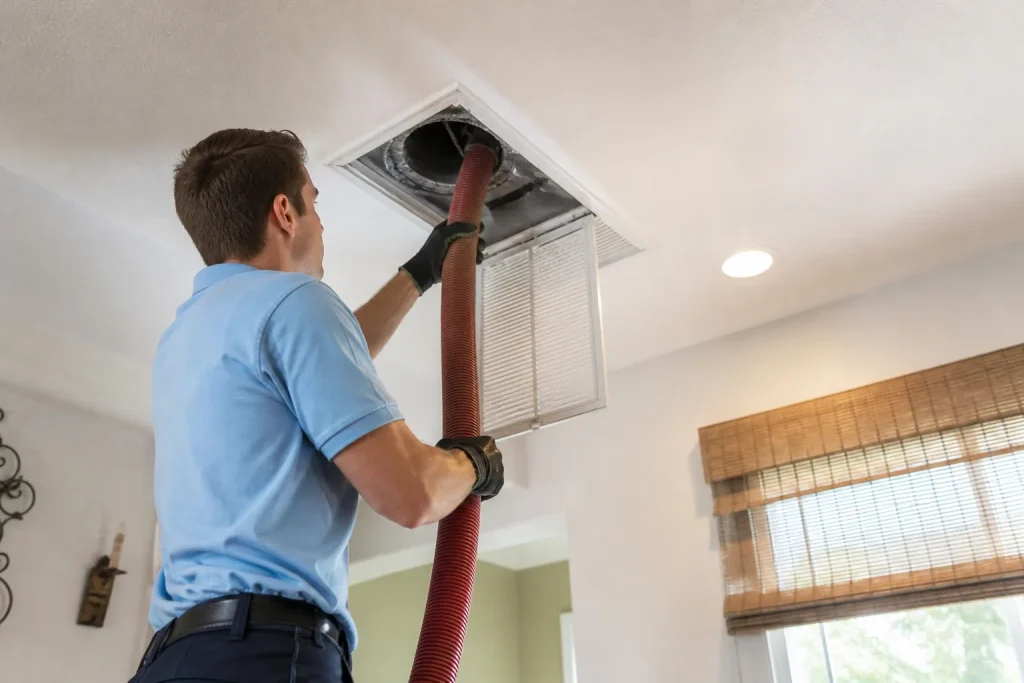
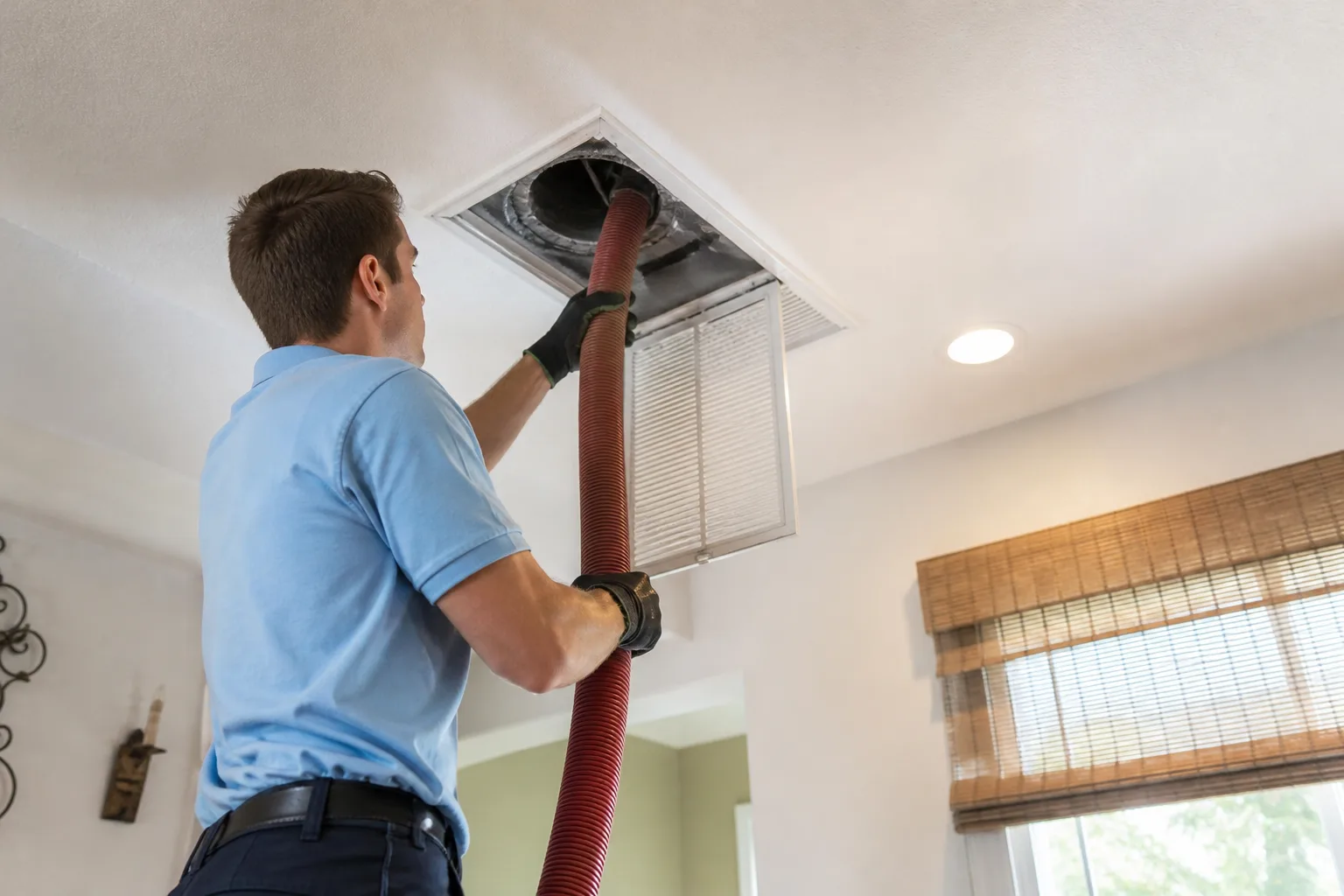
Air Duct Cleaning: Repair or Replace? How Mission Viejo Homeowners Decide
Cleaning deteriorated flex duct is like washing a cracked windshield. The system looks attended to, but the underlying failure is still losing you conditioned air into your attic. In Mission Viejo, the decision between cleaning, repairing, and replacing ductwork almost never comes down to age alone. It comes down to where the system is failing and whether cleaning can actually address that failure or just mask it. Here’s the framework we use to sort it out.
What Do You Actually Find Inside Mission Viejo Ductwork?
Across Mission Viejo, we tend to see four distinct failure modes in attic duct systems, and they call for very different responses. Cleaning solves some. Repair solves others. Only replacement solves the rest.
- Particulate buildup – dust, drywall dust, construction debris, and general household accumulation. Cleaning addresses this directly and completely.
- Biological contamination – mold, mildew, or musty microbial growth, often where condensation has collected or where a disconnected run has been pulling humid attic air. Cleaning plus sanitizing handles the surface; the moisture source has to be fixed too.
- Mechanical disconnection – a flex run that has slipped off a boot, a collar that was never taped properly, a joint that separated when the attic got hot. Cleaning does nothing here. This is a repair.
- Material degradation – the outer jacket of flex duct breaking down, the inner liner torn or collapsed. Once the liner is compromised, no amount of cleaning restores it.
The mistake we see most often in Mission Viejo is a homeowner booking a cleaning to fix what is really a disconnection or a degraded jacket. The ducts come out looking cleaner, the dust on the furniture comes back in a week, and everyone is frustrated. An air duct cleaning only delivers its value on a system that is structurally sound to begin with.
How Do You Read a Duct Leakage Test?
A duct leakage test tells you what percentage of your conditioned air is escaping before it reaches the rooms. In our experience across Mission Viejo homes, that number is what sorts a sealing job from a replacement job, far more reliably than the age of the ductwork.
Here’s the rough interpretation we use:
- Under roughly 10% loss – the system is tight enough. Cleaning is usually the right call, and sealing may not be needed at all.
- Roughly 10% to 25% loss – this is the band where targeted sealing makes real sense. Sealant systems like Aeroseal can reach small leaks from the inside, and a technician can manually seal the accessible joints and collars at the same time.
- Above roughly 25% loss – at this level, you’re usually looking at multiple compromised runs or a jacket that has failed in several places. Sealing a system that is falling apart is treating the symptom.
Those thresholds aren’t a law of physics; they’re a practical guide. A leakage test result combined with a camera inspection gives you the actual picture. If you’re in Mission Viejo and want the whole system cleaner and tighter, our HVAC cleaning service covers the air handler and coil side as well, because a dirty coil and a leaky duct network tend to feed each other.
Why Does Flex Duct Fail in Southern California Attics?
Flex duct fails from the outside in. In a Southern California attic, the outer jacket takes the punishment long before the inner liner does, and that’s the part most homeowners never see.
Three things drive it in Mission Viejo:
- Heat cycling – attics here swing between cool nights and very hot afternoons. That expansion and contraction works on the tape, mastic, and jacket seams over and over.
- UV exposure – any flex run near a vent, a gable, or a gap in the attic envelope gets sunlight, and sunlight embrittles the plastic jacket. Once it’s brittle, it cracks at the flex points.
- Pest activity – rodents and insects in attics chew and nest in the insulation and the jacket. A small chew point becomes a full tear as the system pressurizes and depressurizes every cycle.
What that looks like in practice: the jacket is cracked, flaking, or hanging in strips, but the inner liner still looks intact from the register. That’s the deceptive case. The system is losing air into the attic, but a visual check at the grille tells you it’s fine. Only a camera run down the length of the duct shows the real condition. This is where a Mission Viejo Air Duct Cleaning Pros inspection earns its keep, because the register tells you almost nothing.
What Does a Camera Inspection Show That a Register Check Can’t?
A register check shows you the last six inches of a duct. A camera inspection shows you the whole run: the interior surface, the liner condition, the joints, the boots, and where the duct passes through unconditioned space. That scope report is what should drive the clean/repair/replace decision, before any work is priced.
Here’s what the camera typically reveals in a Mission Viejo attic system:
- Interior liner condition – intact, delaminated, or torn.
- Jacket condition – sealed, cracked, chewed, or UV-degraded.
- Joint integrity – taped, mastic-sealed, or separated.
- Internal debris type – drywall dust, insulation fibers, biological growth, or pest material.
- Moisture – condensation staining, active damp spots, or evidence of past water intrusion.
That report is the difference between a guess and a plan. You should be able to see the findings before you approve the work. We use Abatement Technologies containment equipment during service specifically so that contamination isn’t spread through the house while the inspection and cleaning are underway, and professional-grade Rotobrush and Nikro systems for the cleaning itself. If you want the whole picture, our dryer vent cleaning inspection often turns up the same kind of hidden degradation, since that’s another flex run in the same hot attic environment.
When Is Cleaning Actually Worth It, and When Is It a Waste?
Spending money cleaning a system that needs repairs first is a waste. Spending it as a diagnostic step on a system that’s structurally sound is a reasonable use of money. The difference comes down to one question: is the system losing air before the air reaches the room?
If the answer is no, cleaning delivers the full benefit. If the answer is yes, cleaning delivers a fraction of the benefit and the leak keeps pulling attic dust into the system.
A practical way to frame it for a Mission Viejo home:
- System is tight and contamination is the problem – clean, sanitize if needed, and consider a post-cleaning Guardsman-line treatment to protect the duct surfaces.
- System leaks moderately and contamination is present – repair and seal first, then clean. Cleaning a leaky system pulls attic air in during the process.
- System has a degraded liner in multiple runs – replace those runs. Cleaning a torn liner is cleaning something that’s going to fail again.
- System is tight, contamination is minimal, and the complaint is air quality – the answer may be filtration, not cleaning. That’s where products from Honeywell and Aprilaire come in, and a whole-home filter or a UV component can solve a problem cleaning won’t.
When to call a pro
If you’ve got dust appearing on surfaces within days of cleaning, a musty smell when the system runs, or a room that never gets the airflow the others do, that’s a signal to get a camera inspection before you spend another dollar on cleaning. Cleaning alone doesn’t fix those; the scope report does. We answer 24/7. Fast dispatch from 7am to 7pm, Sunday through Friday. You can also call (877) 883-1452 to set up a free estimate.
What Does the Money Look Like Over the Life of the System?
Most Mission Viejo homeowners want to know the break-even point. Cleaning, repair, and replacement are all priced per job by written estimate, but the general shape of the decision is worth understanding.
- Cleaning is the lowest cost and is the right answer when the system is sound. It’s a routine cost, not a repair.
- Repair and sealing costs more than cleaning but preserves the existing ductwork and restores performance. This is usually the best value when the liner is intact and only the jacket and joints have failed.
- Replacement of individual runs costs more than sealing but less than a full system replacement. This is the right call when the liner is compromised and the run cannot be reliably cleaned.
- Full system replacement is the largest investment and only makes sense when most runs are degraded or the layout itself is causing the leakage.
The framing we offer: think of cleaning as maintenance, repair as correcting a defect, and replacement as rebuilding what’s lost its integrity. Each one is correct in a different situation. None of them is correct as a default. That’s why the inspection comes first, and why we show you what we find before we start and after we finish.
The Bottom Line
The clean/repair/replace call in Mission Viejo rests on where the ductwork is failing, not how old it is. Particulate and biological contamination respond to cleaning and sanitizing. Disconnection and jacket failure respond to repair and sealing. Liner degradation responds to replacement. Reading the leakage test and the camera report gives you a plan you can trust instead of a guess.
Professional-grade equipment, not big-box tools, is the reason the inspection actually tells you something. Abatement Technologies containment keeps the job clean while it’s happening, and Rotobrush and Nikro systems do the work properly. Clean ducts. Sealed ducts. Healthy air.
If you’re in Mission Viejo and need help deciding what your system actually needs, Mission Viejo Air Duct Cleaning Pros offers free estimates. Call (877) 883-1452. We answer 24/7. Fast dispatch from 7am to 7pm, Sunday through Friday. Our technicians have up to 11 years of experience, and every job starts with the estimate in writing.
Frequently Asked Questions
The answer comes from an inspection, not from the age of the ductwork. A camera run through the system shows whether the interior liner is intact (cleaning is appropriate), whether joints and jackets have failed (repair and sealing are appropriate), or whether the liner itself is torn or collapsed (replacement is appropriate). Request a camera inspection and a duct leakage test before any work is priced.
You can, but the benefit will be short-lived if the system is leaking. Cleaning removes the contamination, then the leak pulls attic air back into the ductwork, and the dust returns within days. If the leakage test shows the system is losing air, repairing and sealing first is usually the better sequence.
There’s no fixed number, because heat cycling, UV exposure, and pest activity vary house to house. What we see consistently in Mission Viejo is that the outer jacket degrades before the inner liner, so the duct looks fine at the register but is failing behind the drywall. The camera inspection tells you the actual condition of your particular runs.
That’s often the right call. Individual degraded runs can be replaced or resealed without touching the runs that are still sound. The scope report will identify which runs are failing and which aren’t, so you’re paying for the work that actually solves the problem. Call (877) 883-1452 for a free estimate – we’ll walk you through the findings before any work is booked. We answer 24/7. Fast dispatch from 7am to 7pm, Sunday through Friday.
Written by the team at Mission Viejo Air Duct Cleaning Pros.
Need Air Duct Cleaning Help?
Call Mission Viejo Air Duct Cleaning Pros - the local pro we connect you with is licensed and insured, with free written estimates in Mission Viejo.
(877) 883-1452