
Nikro Air Duct Cleaning in Mission Viejo: A Homeowner’s Guide
Nikro builds some of the most widely deployed professional duct cleaning equipment in the country, but the brand name on the machine tells you almost nothing on its own. A Nikro negative pressure unit is powerful enough to shed loose lining inside deteriorated flex duct if it’s run at full extraction without the right agitation sequence first. Same equipment, very different outcomes in skilled hands versus rushed ones. This guide explains what that equipment is actually designed to do, so you can watch a Mission Viejo service call and know whether it’s being run correctly. If you’d rather leave it to a trained crew, call (877) 883-1452 for a free estimate.
What does a Nikro negative pressure unit actually do?
A Nikro negative pressure unit creates a controlled vacuum across the whole duct system while a technician agitates debris loose from the interior walls, pulling it toward a HEPA-filtered collection point instead of into your living room. That’s the entire principle: source removal, not surface cleaning. The machine doesn’t scrub anything. It holds the system under negative pressure and captures what the agitation tools break free.
The equipment is specified for source removal because surface cleaning doesn’t work. Wiping the inside of a visible register or vacuuming the grille does nothing about the settled dust, dander and construction debris sitting along the trunk lines and branch runs. A properly rated negative pressure unit with staged HEPA filtration keeps that material contained and moving one direction – out of the system – rather than redistributing it through the house.
This is where the difference between professional-grade equipment and a big-box shop vac becomes obvious. A consumer vacuum has neither the airflow nor the filtration to hold a whole duct system under negative pressure, and it will spread fine particulate through the exhaust. The equipment used on a real job, whether a Nikro unit or a Rotobrush system, is built for the airflow and containment a residential duct network requires. In our experience, the machinery is the easy part to name and the harder part to run well.
How is a Nikro-based cleaning job set up?
A legitimate Nikro-equipped service call follows a sequence, and that sequence matters more than the brand name. Skipping a step is how ducts get damaged or debris gets left behind. Here’s the order a properly executed job moves through:
- Isolation of the system. The technician shuts down the HVAC equipment and seals off openings so the negative pressure has somewhere to build. Registers and returns are covered or connected to the collection network.
- Negative pressure verification. Before any agitation begins, the unit is running and the technician confirms the system is actually under negative pressure. If it isn’t, agitation just spreads debris.
- Access point placement. The technician cuts or opens access at strategic points along the trunk and branches so every run can be reached, not just the ones near a register.
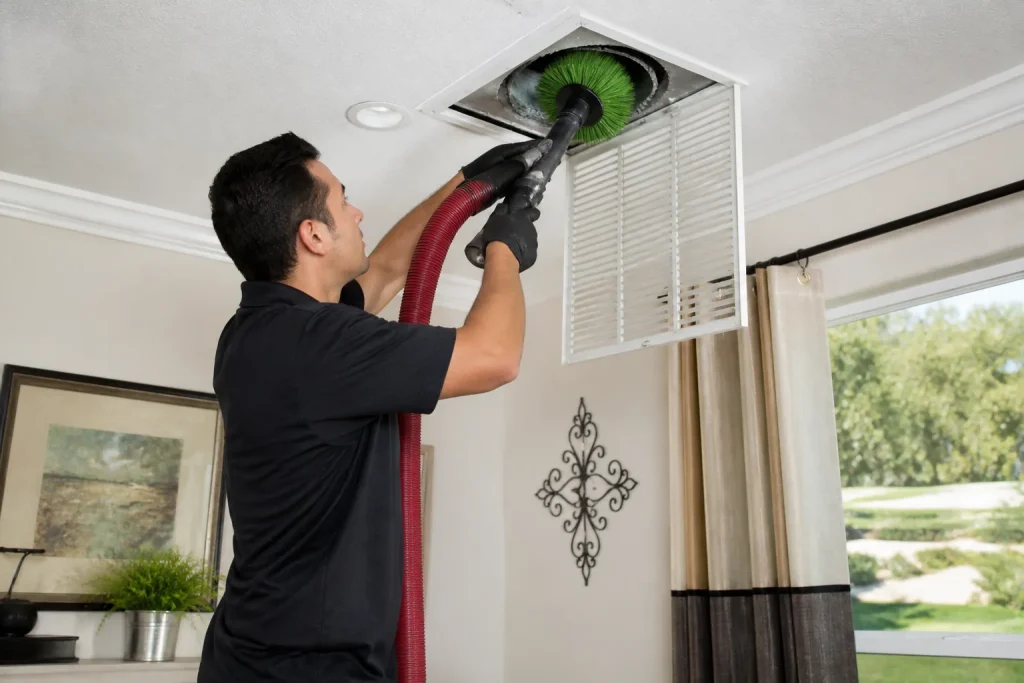
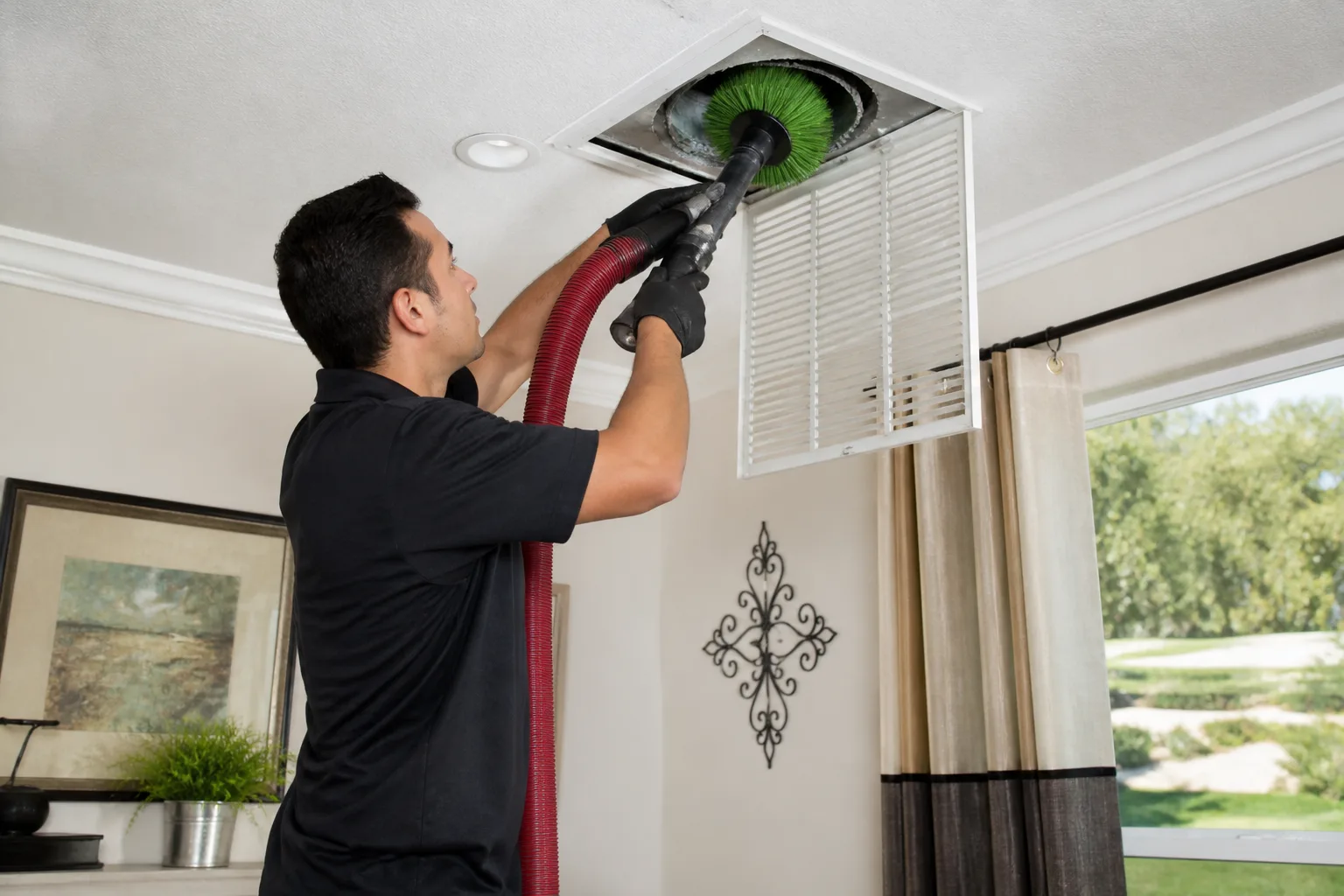
- Agitation tool sequencing. Mechanical agitation – brushes, air whips or similar tools – loosens debris from the duct walls, working in a planned order from the far runs back toward the collection point.
- Extraction and containment. The loosened material is pulled into the collection unit and captured by the HEPA stages. Nothing gets pushed into the living space.
Notice that agitation comes after pressure is established, and extraction runs throughout. A crew that agitates first and vacuums later has the order backwards. When you’re comparing quotes for air duct cleaning in Mission Viejo, that sequence is worth asking about directly.
What should you see and hear during a real Nikro service call?
You don’t need to understand CFM ratings to tell whether the equipment is doing its job. There are observable signs during a legitimate service call in Mission Viejo that separate a real source-removal job from a quick pass with a vacuum hose.
- The unit runs continuously. A proper negative pressure unit is on for the bulk of the job, not switched on for a few minutes at the end.
- You hear the agitation tools working. Brushes or air whips make a distinct sound as they travel the duct runs. Silence from the ducts while a machine hums in the driveway usually means the agitation step is getting skipped.
- Containment stays in place. Openings are sealed, drop cloths are down, and there’s no visible dust plume or haze in the room.
- Access points are opened, not guessed at. The technician works at multiple points along the system, not just the registers you can see.
- There’s a before-and-after record. We show you what we find before we start and after we finish, which is the simplest way to verify the work actually happened.
If the equipment is running but none of the above is happening, the Nikro name on the machine isn’t doing you any good. The brand is a starting point, not proof.
Why does the same Nikro equipment give inconsistent results?
The same Nikro system can produce an excellent result in one home and a half-finished one down the street, and the variable is always the operator. Three things separate a competent technician from someone who bought the equipment and read the manual once:
Operator training. Knowing the unit’s airflow limits, how to read negative pressure, and when to dial back extraction on fragile duct runs is training, not equipment. Our technicians have up to 11 years of experience, and that time is spent learning these operating parameters, not just carrying the machine.
Access point placement. Every branch run needs to be reachable. A technician who opens one or two access points and works only what’s closest is leaving most of the system untouched, and the equipment can’t pull debris from a run it can’t reach.
Agitation tool selection. Different duct types call for different tools. Flexible duct needs a gentler approach than rigid metal, and running full extraction without the right agitation sequence on deteriorated flex lining can cause the lining to shed. Matching the tool to the material is a judgment call, not a setting.
This is why we pair the machinery with containment discipline and a documented process. The same equipment used in commercial remediation, applied with that standard, is what makes the difference in a Mission Viejo home.
What should you ask a Mission Viejo contractor who cites Nikro equipment?
If a contractor leads with the Nikro name, the right follow-up questions verify they understand the system’s operating parameters and not just its brand. Ask these before you book:
- How do you verify negative pressure before you start agitating?
- Where will you place access points, and will every branch run be reachable?
- Which agitation tools do you use for flexible duct versus rigid metal?
- What containment and HEPA filtration is running during the job?
- Will I see before-and-after documentation of my own ducts?
- Is the price one flat price for the whole system, or is it billed per vent once the technician is on site?
That last question matters most, because per-vent pricing is where the low-quote bait-and-switch usually lives. One flat price per system, agreed before work starts, is the honest standard. If you’re also thinking about the other end of your air system, dryer vent cleaning is worth scheduling in the same visit, since a clogged dryer vent is a household fire risk that duct-only operators routinely skip.
In our experience, the questions a contractor answers easily – and the ones they fumble – tell you more than any brochure. A crew that can explain its airflow setup and agitation order knows its equipment. One that only repeats the brand name usually doesn’t.
When to call a pro
Some duct problems are worth a look and some are worth a call. A single dusty register you can wipe clean is a look. Visible dust blowing from the vents within days of cleaning, a musty smell that returns whenever the system runs, a recent move into a Mission Viejo home with unknown duct history, an allergy flare-up that tracks with the HVAC cycling, or a dryer that takes two cycles to dry a load are all calls. Deteriorated flex duct lining and sealing gaps in the system are calls too, since both affect how well the whole system holds pressure.
We handle the full indoor air quality chain in one relationship: cleaning, dryer vent safety, HVAC cleaning, and duct repair and sealing. That covers the systems most companies overlook. If you’d like a clear explanation of what’s happening in your ducts and one flat price before anyone starts, call (877) 883-1452. Estimates are free. And yes, we’ll show you what we find.
The Bottom Line
The Nikro name on the machine is a starting point, not a guarantee. What produces a clean, undamaged duct system is the sequence: isolation, verified negative pressure, planned access, correct agitation, and HEPA containment throughout. The equipment is professional-grade; the outcome depends on the technician running it. Ask the questions above, listen for the agitation tools, and insist on one flat price per system and before-and-after photos. That’s how you tell a real source-removal job from a surface pass. If you’re in Mission Viejo and need help, Mission Viejo Air Duct Cleaning Pros offers free estimates. Call (877) 883-1452. We answer 24/7. Fast dispatch from 7am to 7pm, Sunday through Friday.
Frequently Asked Questions
Whole-system air duct cleaning is priced as one flat price per system, not per vent, and the written estimate sets the final price. We don’t quote a teaser coupon figure, because that’s exactly how a small job becomes a much larger invoice once the technician is on site. Call (877) 883-1452 for a free estimate on your exact system.
Cheaper quotes usually mean per-vent pricing, a shop vac instead of a rated negative pressure unit, or skipped agitation and containment steps. The machine may even be the right brand. What’s missing is the operating discipline. One flat price per system, agreed up front, is the honest baseline. Call (877) 883-1452 for a free estimate.
Ask for before-and-after photos of your own ducts and watch that the negative pressure unit runs throughout the job and the agitation tools are actually working the runs. Those observable signs are the simplest proof. We document both ends for you. Call (877) 883-1452 to book a free estimate.
There’s no universal schedule. Homes with pets, recent renovations, allergy concerns or unknown duct history benefit sooner, and most homes fall somewhere in a multi-year range. The honest answer depends on what’s in your system, which is why we show you what we find. Call (877) 883-1452 for a free estimate.
Written by the team at Mission Viejo Air Duct Cleaning Pros.
Need Air Duct Cleaning Help?
Call Mission Viejo Air Duct Cleaning Pros - the local pro we connect you with is licensed and insured, with free written estimates in Mission Viejo.
(877) 883-1452